

Originally published in Travel+Luxury, The Australian, by Louise Roddon
I’m attacking a slab of fillet steak with a knife so Provençal sunshine floods the terrace; inside, all is concentration and cool air. Then our tutor appears at my shoulder and casts a critical eye over my work. “Remember, Louise,” he says, dryly, “the steak tartare is for the canapés, not dessert.”
Alongside eight fellow students I’ve joined a cookery week in Provence with Stirred Travel, learning from Neil Borthwick, head chef of The French House, the acclaimed pub-restaurant in London’s Soho. A former protégé of the celebrated Michel Bras, Borthwick wears his experience lightly. My glacial knife work may be the target of his sarcasm, but there’s also encouragement, and as our days unfold, the occasional affectionately deployed swear word.
This is no culinary boot camp. Between classes are trips to local markets, excursions to impossibly pretty villages and twice-daily wine-soaked feasts that we have proudly helped to create. Before long, we’re all quietly convincing ourselves we’ve become competent cooks.
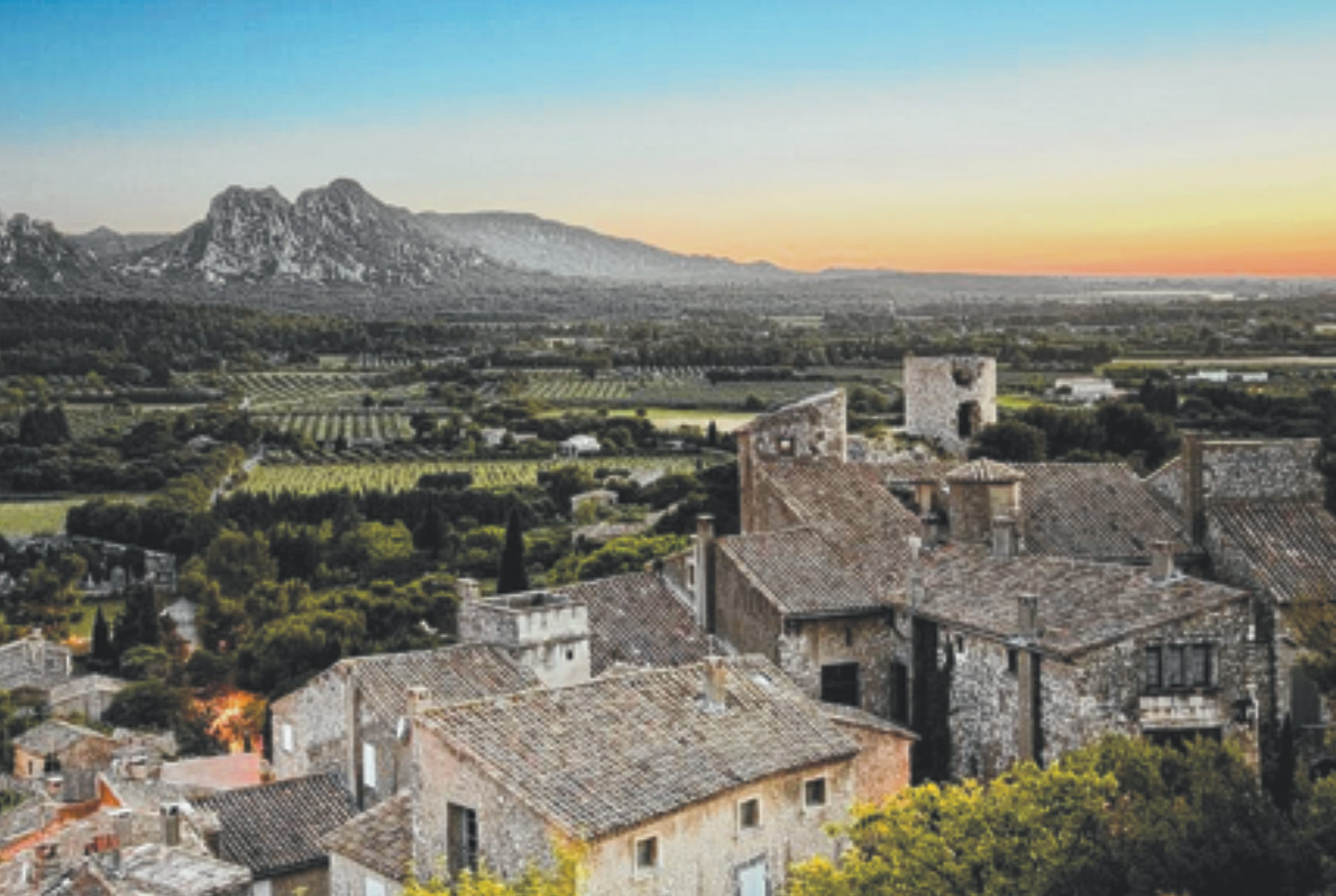
Our base is an 11-bedroom, 18th-century limestone farmhouse set south of the peaks of Les Alpilles. Framed by mature plane trees, extensive gardens and a huge pool, it’s as dreamily atmospheric as a scene from Jean de Florette. Shuttered windows mix with cool flagstone floors and elegant wood-beamed or vaulted interiors decorated with quirky objets d’art. And the kitchen – our learning hub – features a Lacanche stove and enough table space for students to measure, chop and stir.
Being a strong advocate of fuss-free traditional cooking, Borthwick’s recipes focus on Provençal ingredients and flavours. One morning we help assemble a simple lunch of fougasse (flat bread), Pissaladière tart (with caramel onions, anchovies and black olives), velvety ratatouille and pavlova. The next, we are tackling a complicated but encouragingly reproducible dinner of spatchcock quail with celeriac remoulade, endive and hazelnut pesto. Puddings tend towards the showstopping, notably Borthwick’s warm madeleines with lemon curd, and a superb Paris-Brest – akin to a munchy-crunchy eclair – with roasted hazelnuts, chocolate and Chantilly cream.
Yet it’s the savoury dishes that linger in the memory, both for their flavour and their apparent simplicity. I have already earmarked for my family Borthwick’s baked sea bass with lemon thyme, alongside a tender rabbit à la moutarde.
Fortunately, there’s ample opportunity to work up an appetite, even if our sightseeing pace hovers somewhere between leisurely and positively escargot. Saint-Rémy’s Wednesday market – one of the largest in France – treats us to a glorious sensory overload, the town’s handsome honey-toned streets perfumed with lavender, roasting chickens and sun-warmed peaches.
Beneath striped awnings, stallholders hawk everything from creamy tapenades, glossy olives, tomatoes so huge they barely look real, to classically French wicker baskets and overpriced straw hats. In contrast, tiny Eygalières opens to a skinny trail of stalls and sleepy cafés clustered beneath a ruined castle.
As ever, food remains the common thread. At a nearby farm, La Fromagerie des Alpilles, we sample a variety of nutty goat’s cheeses before I become hopelessly distracted by a one-week-old kid – all velvet ears, warm fur and uncertain legs – that seems perfectly content to spend time asleep in my arms. It’s difficult to imagine a more charming interruption.
The surrounding Luberon villages are every bit as seductive. We wander the steep cobbled lanes of Oppède-le-Vieux, bougainvillea tumbling over ancient stone walls, before continuing to breezy hilltop Ménerbes, forever associated with Peter Mayle.
It was here that Mayle wrote A Year in Provence, the bestselling memoir whose success attracted so many admirers, he eventually felt compelled to leave. Standing in the village square, gazing onto a patchwork of lavender fields and vineyards, dark cypresses adding vertical contrast, it’s easy to understand why the author fell under its spell.
Our own cooking provides the week’s centrepiece, but the meals away from our farmhouse are no less memorable. One lunchtime we gather beneath reed-shaded trestle tables at Edu Restaurant near Saint-Rémy for leisurely alfresco sharing plates; another evening, in nearby Paradou, several guests summon the courage to try snails. Not a first for me, but for the others they prove more palatable than expected.
By our final night, the farmhouse feels like a second home, and our group, ranging in ages from 50 to 70-plus, has bonded. Dishes are assembled with greater confidence, the corks are pulled more copiously, and conversation flows as readily as the pale Provençal rosé. Above us, stars dazzle with the intensity of a van Gogh as we laugh over culinary mishaps and newly acquired kitchen skills.
We may not be accomplished chefs, but we depart with a handful of recipes, renewed confidence, and for me at least, the pleasure of feeling my knife moving rather faster than it was on day one. A small triumph, yes, but it feels deeply satisfying.
